
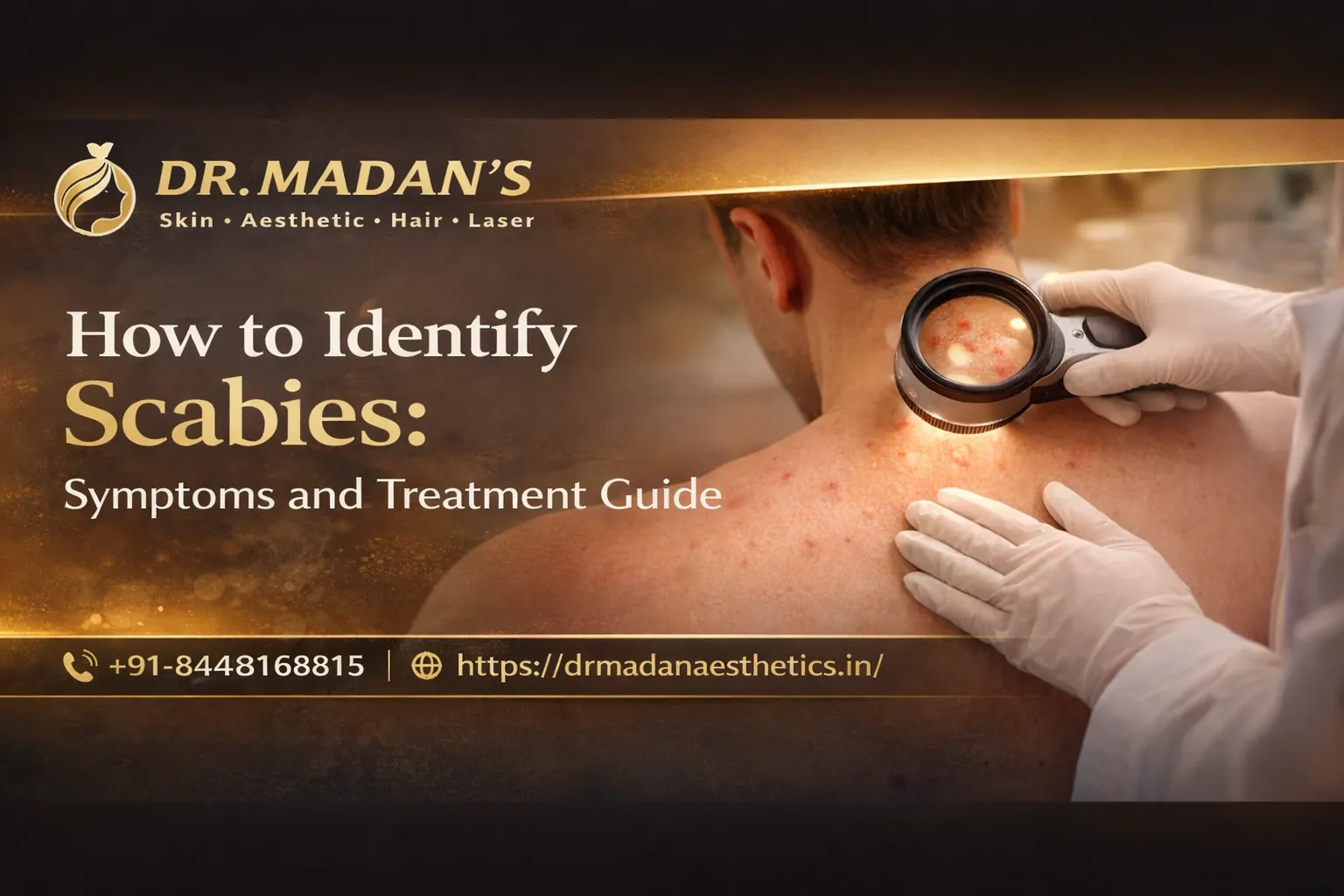
A scabies rash is small but causes far more distress than you could guess. And the causative agent here is microscopic.
Scabies is among the most uncomfortable skin conditions seen in clinical practice, while also being one of the most misunderstood. Despite the distress it causes, it can be treated easily if diagnosed early. The key is to know and identify the scabies symptoms in time.
Read on to learn how to identify scabies, its cause, how it spreads, and more.
How to Identify Scabies Early Before It Spreads to Others?
Scabies is caused by a microscopic mite known as Sarcoptes scabiei. While you cannot see them with the naked eye, their effects on your skin are unmistakable once your immune system reacts to them.
How do Mites Infect the Skin?
Scabies is caused by direct, prolonged skin-to-skin contact with an infected person. During contact, the fertilized female mite burrows into the stratum corneum, which is the outermost layer of the skin. There, she creates tiny tunnels to lay eggs.
Over the next several days:
- Eggs hatch into larvae
- Larvae mature into adult mites
- The cycle continues within the skin
It is important to understand that scabies is not related to poor hygiene. The mites causing this condition do not jump, fly, or spread through dirt.
Due to this, scabies commonly affects:
- Household members
- Sexual partners
- Individuals in dormitories or hostels
- Residents of long-term care facilities
Symptoms May Appear Weeks After Exposure
With scabies, there is a significant delay between exposure and symptoms.
Individuals who have never had scabies before often experience itching and rashes after about 2 to 6 weeks of exposure. While mites reproduce under the skin during this period, the person might not feel anything amiss.
This delay is because the symptoms are primarily caused by an allergic reaction. It takes some time for the immune system to recognize the mite proteins, eggs, and waste products as foreign. Once it does, it initiates inflammation, and itching begins.
In contrast, individuals with a history of scabies may develop symptoms within a few days of re-exposure. This is because the immune system already remembers the foreign entity from the previous episode.
Scabies Can Spread Without Visible Signs
Due to the delayed immune response, scabies can often spread before the individual becomes aware of the condition.
Transmission can take place:
- During shared sleeping arrangements
- Through intimate contact
- With prolonged skin contact in caregiving situations
In case of heavy mite infestation, scabies may spread through shared clothing, bedding, or towels. This is, however, very uncommon.
The First Signs of Scabies Most People Ignore
Scabies almost always presents itself with subtle symptoms. This is a major reason for delayed scabies treatment. If you wish to know how to identify scabies early on, knowing the symptoms discussed below will help you.
1. Intense itching, especially at night
The most characteristic scabies symptom is persistent itching that becomes worse at night.
People with scabies often report:
- Restlessness in bed
- Waking repeatedly in the night to scratch at the rash
- Feeling more aware of itching once lying down
With scabies, the itching worsens during the night mainly because:
- Mites are more active in warmth
- Lack of any distractions makes the sensation more noticeable
2. Pimple-like rash and small, red bumps
During the initial stage, a scabies rash typically appears as small, red bumps or pimple-like breakouts. Some people may also develop tiny blisters.
At this point, these rashes are often mistaken for:
- Acne
- Heat rash
- Insect bites
- Mild allergic reactions
Over time, the rash spreads to multiple areas rather than remaining confined to one spot.
3. Early allergic reaction to mites under the skin
It is important to understand that itching in scabies is not caused by mites crawling across the skin. Instead, it is caused by your immune system targeting the foreign matter.
Your immune system detects and attacks:
- Eggs
- Mite saliva
- Waste material deposited in the burrows
This inflammatory reaction can make the itching feel severalfold more severe than the visible rash. While some individuals develop widespread redness with discomfort, others experience minimal visible changes but intense distress.
What Does Scabies Look Like on the Skin?
When learning how to identify scabies, you must know what scabies rashes look like on the skin. While they can resemble other dermatological conditions, certain patterns are highly characteristic.
1. Burrow marks that appear as thin, wavy lines
When it comes to appearance, the most distinctive feature of scabies is the burrow.
It often appears as:
- A thin, slightly raised line
- Wavy or serpiginous in shape
- Skin-colored, grayish, or faintly red
Sometimes, people report a tiny dark dot at one end of the burrow. This represents the mite. Kindly note that these burrow marks are not always easy to detect and may require careful inspection under good lighting. They are more visible in areas with thin skin.
2. Common body areas affected
In adults, scabies mostly affects:
- The spaces between fingers
- Inner wrists
- Elbows
- Waistline
- Groin
- Around the nipples in women
- Genital region in men
The distribution of rashes is often symmetrical and widespread.
Scabies in infants and young children often manifests in the scalp, face, palms, and soles.
3. How rashes may look like
Not all people with scabies display obvious burrows. More commonly, the rash resembles:
- Scattered red bumps
- Bite-like lesions
- Small blisters
- Hive-like raised patches
Due to this overlapping symptom, scabies is often mistaken for eczema or allergies.
However, eczema is characterized by chronic dry patches and usually does not cause sudden and severe nighttime itching affecting multiple household members.
Individuals with a weakened immune system may develop thick, crusted lesions. This severe form contains a large number of mites concentrated at a place and requires urgent medical treatment.
How Doctors Confirm if it is Really Scabies or Another Skin Problem?
From the previous sections, you know how to identify scabies and seek early medical attention. However, scabies can often be mistaken for atopic dermatitis, contact dermatitis, allergic reactions, fungal infections, and insect bites, which have some similar symptoms. Apart from some characteristic signs of scabies discussed earlier, an expert opinion can help distinguish these conditions.
This section talks about how the experts confirm a scabies diagnosis. It relies on careful clinical observation and evaluation.
Clinical Examination Based on Typical Symptoms
In many cases, experts can diagnose scabies based on the following symptoms:
- Persistent nocturnal itching
- Characteristic rash distribution
- Visible burrows
- Similar symptoms in people in close contact
When these factors align, further tests might not be necessary.
Skin Scraping or Microscope Test
Appearance-wise, if the symptoms are unclear, your doctor would suggest a skin scraping test. It involves scraping a small sample from a suspected burrow to examine it under a microscope.
This test looks for:
- Mites
- Eggs
- Fecal pellets
Identifying any of these elements confirms the diagnosis.
Take note that a negative microscopic test does not entirely exclude scabies. A false negative is possible if the number of mites in the tested infested site is low. Often, if there are fewer than 15 mites at a site, they might not get captured in the sample.
When Should You Suspect Scabies and Seek Treatment Immediately?
Timely scabies treatment can save you a lot of discomfort and prevent the condition from spreading further.
This section talks about some strongly indicative factors of scabies. If you experience one or more of these, seek medical attention immediately.
1. Persistent night itching and spreading rash
You should consult a dermatologist if you experience itching that:
- Persists beyond a week
- Worsens at night
- Does not improve with basic skincare
The rash is more likely to be scabies if it gradually spreads to typical areas like the hands and waist.
2. Similar symptoms among people in close contact
If one or more people in close contact with you begin to experience similar itching, immediate medical evaluation is recommended. All affected individuals should preferably receive treatment simultaneously. This helps prevent reinfestation.
3. Signs of skin infection due to continuous scratching
A scabies rash can cause vigorous itching. Continuously scratching at it can break your skin barrier and allow bacteria to enter. This can lead to a skin infection.
Look out for the following signs of a skin infection:
- Increasing redness
- Warmth
- Swelling
- Pus
- Fever
In case of infection alongside scabies, medical intervention becomes urgent. The doctor might prescribe some antibiotics along with the typical scabies treatment to effectively address the situation.
Prevent Complications with Early Recognition
Scabies is intensely uncomfortable. However, it is also entirely manageable. Provided you notice the signs early on and seek medical advice.
With the knowledge of how to identify scabies through characteristic signs like worsened nighttime itching and rash patterns, you can seek early treatment. Early recognition can make treatment for scabies a lot simpler and limit its spread.
There is no stigma or shame associated with scabies. It is simply a contagious skin condition that can affect anyone. Effective treatment for the condition is readily available, and you can tackle the condition with the proper medical care.
The first step to tackle scabies is awareness. When symptoms fit the pattern, do not hesitate to seek medical consultation.